Showing posts with label Sustainability. Show all posts

Issue Investigation: Waste No More

Environmental Education Topic for January:  


Issue Investigation: Waste No More!

New Year's Resolution: Create no trash.
Doh! So hard to do!

However, encouraging a group of Club kids to develop a waste management system for the Club can lead to significant successes. As the kids become leaders in the Club community and their work visibly reduces Club waste, they gain confidence and self-efficacy. And this will enable them to investigate and solve environmental issues in the future. Let the kids lead, experiment, and work as a team as you offer support and guidance.


Activities:
Trash Detectives
Kids can sort through trash cans to discover the percentage of compostable, reusable, and recyclable materials (Hey a math lesson too!). This information will frame the issue. Does the building need more compost and recycling bins? Does the Club community need more information or encouragement? What is the problem and how can it be solved? This activity can be done periodically throughout the year to measure success. Tip: dump trash cans out onto a tarp and provide everyone with gloves.
More activities and ideas can be found here: http://www.greeningschools.org/resources/view_cat_teacher.cfm?id=79


Communication and Marketing
Signs and labels can educate and motivate the Club community to recycle or compost. What should the signs look like? Kids can do research on the internet and think about signs they may have seen at their school or in restaurants. Make signs and labels using the computer, with pens and paper, photographs, or paint. Maybe a kid cartoonist can draw a mascot for the program. Incentives can be thought of for rooms or groups that reduce the amount of waste produced. Flyers, stickers, and information can be given to kids and families. Go to the Seattle Public Utilities page for posters you can print.


Public Service Announcements
After the kids have thoroughly investigated the problem, reflected on why it is important to solve, and developed some solutions, it is time for them to share their knowledge. The kids can deliver a presentation for the entire Club, host an educational event fair, or make a PSA that can air on Club computers and be given to families.

The Mercer Island Compost Heroes created the Where Does It Go? Game Show to present information to the Club. 

.


Joel E. Smilow Club at Rainier Vista kids worked with SCAN Youth Media to make a recycling PSA, learning videography in the process. If your Club does not have a video camera, you can borrow one from the CSC; ask Erin or Rachel.


Recycling may not fully solve all our environmental issues. But! It is a way for kids to affect visible positive change. If they research the problem, become invested in developing a solution, and achieve results, they gain an experience rarely encountered in school or home life. The experiences and skills developed will encourage kids to use innovative thinking to find solutions  in the future.


Recycled Gifts

Environmental Education Topic for December:
Recycled Gifts
 
It's time to start crafting for holiday gift giving. Who wants a tin can pencil holder?  
No. I already have ten. 
But it's recycled! 
Umm. So?

There are plenty of amazing ways to reuse objects destined for the landfill or recycling center. And not all of them are pencil holders! The craft ideas suggested below can be used for holiday gifts and can inspire discussions on product lifespan, the waste stream, and stewardship. The processes of decomposition and biodegradation ensure efficient recycling of organic materials; creating soil, feeding creatures, sustaining plants. What happens to our waste products? What do they nourish? And how can we reduce waste? Get crafty and reuse!

Activities:

Decoupaged Votive Candle Holder
Materials: glass jars, mod podge, pressed flowers and leaves, tissue paper, scissors, brushes
Procedure: Collect and press flowers or leaves to dry them out. Or cut colored tissue paper into shapes such as starts, moons, butterflies. Cover jars with mod podge. Stick on leaves, flowers, or shapes, cover with more mod podge. tear white tissue paper into pieces and stick on jar. Cover with more mod podge. Let dry. Place votive candle inside.

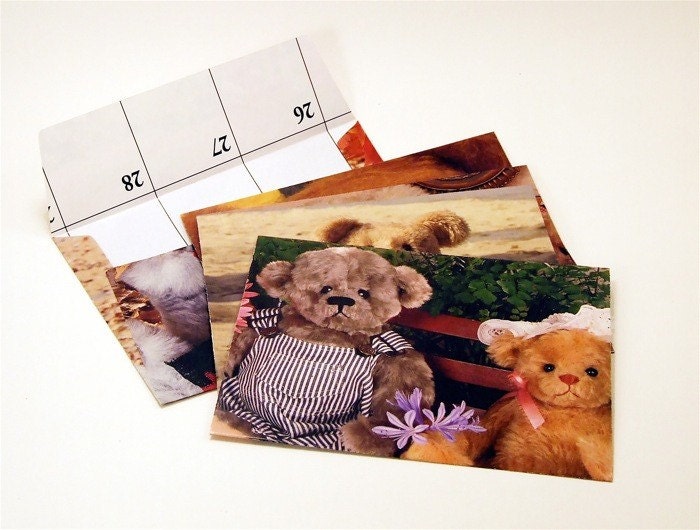
Recycled Calendar Stationery Set
Materials: old calendars, paper, pens, glue, scissors
Procedure: Use the template provided on the site below to trace and cut calendar pages into envelopes. Use the small pictures on the back of the calendar for the stationary. Glue a small picture to the corner of a piece of paper. Create a decorative border with pens.

Recycled T-Shirt Bag
Materials: t-shirts, sewing machine or needle and thread, scissors
Procedure: Cut off the arms of the t-shirt. Cut a hole around the neck. Turn it inside out and sew up the bottom.
For an entire book on how to turn t-shirts into other t-shirts (but cooler!) check out Generation T: 108 ways to Transform a T-Shirt from the Seattle Public Library

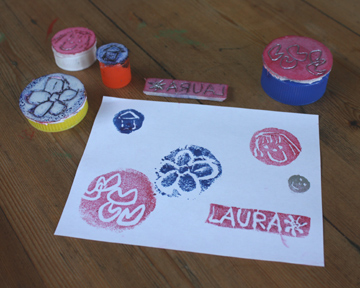
Cap Stamps
Materials: plastic soda bottle or container caps, styrofoam trays, pens or pencils, ink pad, scissors, glue
Procedure: Trace the bottle caps on the stryofoam and cut out. Draw designs into the styrofoam. Glue to bottle caps. Use as stamps in ink pad


Easy Weave News-Print Basket
Materials: newspaper, plastic jar, scissors, clear tape
Procedure: Cut the newspaper into strips. Tape two strips together to form a cross. tape another two on top to create an asterisk. Place this on the bottom of a jar and fold the strips up the side and over the lip of the jar. Weave strips horizontally around the jar, taping at the ends. Remove the jar and tape vertical ends under.

Tin Can Robots
Materials: tin cans, random pieces (tin foil, paper clips, bottle caps, wires) hot glue gun
Procedure: Turn tin can into a robot by gluing found objects on as eyes, mouth, arms, antennae 
For more instruction see: http://familyfun.go.com/crafts/crafts-by-material/recyclable-projects/can-do-robots-674831/

Wheeee Water!


Environmental Education Topic for July:
Wheeeeee Water!
Isn't it just so much fun to play with water on a hot day? Yes it is. Now, let's get educational. You can use these activities to discuss conservation, address current environmental issues, and infuse inquiry-based learning into a camp day.


Activities:

Water Cycle Yoga
Make up movements for different stages of the water cycle. Rise up with outstretched arms for evaporation, bring arms into a circle above the head for condensation, wiggle fingers, drop arms, and crouch down for precipitation. How fast can you do it? Water never disappears, it just changes form. Again and again and again. In a cycle. Kids like to hear that the water we are drinking today could have been slurped up by a dinosaur millions of years ago.


Surface Tension Trials
Why are rain drops shaped like rain drops? Why does water appear to extend above a glass when you carefully fill it really full? Surface tension is the attraction of water molecules to each other. Kids can use eye-droppers to count how many drops of water they can fit on a penny. They can try to balance a paper clip on water by sliding it across the cup. And they can amaze friends and family with a magic trick. Sprinkle pepper on a bowl of water. Ask a volunteer to stick a finger in the bowl. Nothing happens. Now, without anyone noticing of course, put a little bit of dish soap on your finger. Stick this finger in the bowl. The pepper will spring out to the edges. The dish soap disrupts the surface tension and the intact tension of water toward the outer edge of the bowl will pull the pepper towards it. Magic! Science! More experiments can be found at http://www.kids-science-experiments.com/cat_surfacetension.html


Build a Watershed
Water flowing from surrounding terrain into a common area is watershed. Animals, plants, and people are connected to each other in this watershed through the flow of water. Kids can get in groups to build a watershed with clay or salt dough. They can make mountains, lakes, rivers, and seas. When they have built a 3D representation of a landscape, they can cover it with saran wrap and spray it with a spray bottle. Where does the water collect? Was it what they expected. Look up and around. Where would we expect the water in our watershed to flow from and to? EPA's Wetlands and Watersheds web page can inform you on local wet features.

Salmon Migration Obstacle Course
Set up an obstacle course with a jump rope for a dam, cones as a fish ladder, and bears and fisherman who can tag salmon. You can require the fisherman to only move one foot, or hop around in a bucket. Discuss the obstacles salmon face as they migrate upstream to the location of their birth. The Washington Department of Ecology provides plenty of information on their Salmon web page.


Plankton Races
Plant (phyto) and animal, (zoo) plankton are food for many aquatic creatures and are an important building block in the Puget Sound food chain. They also are neutrally buoyant; and float around, not on the top of the water, nor the bottom, but in the middle. Can the kids make a neutrally buoyant creature? With a mix of materials, the kids construct their creature and can then test it in a bucket. It is harder then they expect. Some materials might include: sponges, string, washers, pipe cleaners, clothes pins, popsicle sticks, rubber bands, and styrofoam peanuts. Plankton facts and the activity can be found at http://marinediscovery.arizona.edu/lessonsF00/bryozoans/2.html


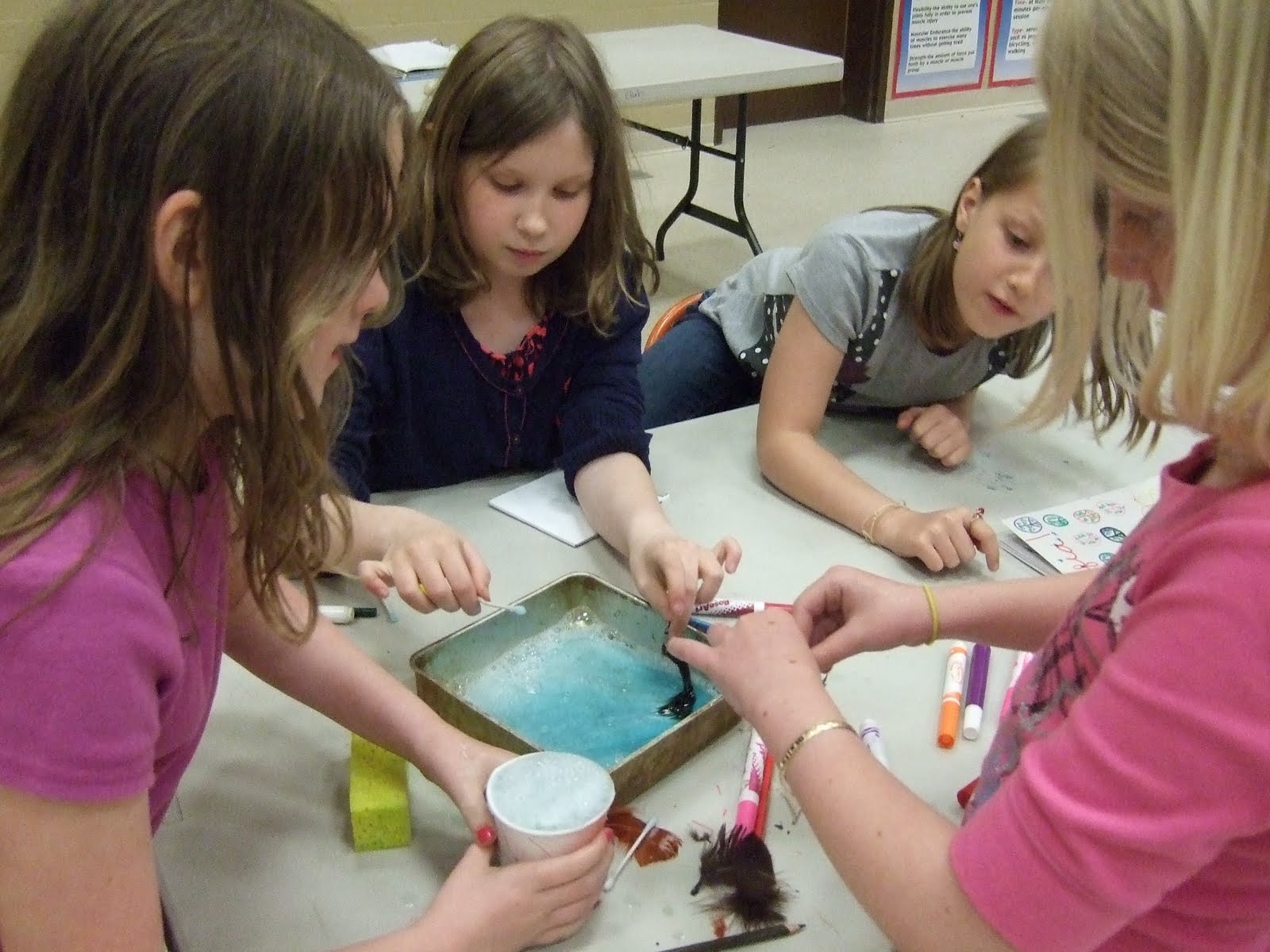
Clean Up the Oil Spill
Put a bit of blue food coloring in pans of water. Add some cooking oil (which you can explain is not quite the same as crude oil) and give kids some cleaning materials such as spoons, sponges, paper, cup of dish soap, etc. Ask teams of kids to try to clean the oil from the pan. What works? What makes more of a mess? Add some feathers to the oil. Do they change? Oil is a problem for the quality of our water in Puget Sound as well as in the Gulf. How does oil get into our water locally? Hint: cars and cement. Find out more on Puget Sound Partnership's website: http://www.psp.wa.gov/oilspills.php


Aquatic Life
What can you find in Lake Washington? A puddle? A stream? Scoop out some water and take a look. You can use magnifying lenses and microscopes. Return the water and it's organisms to the location it was found when the activity is over.

Alternative Transportation


Environmental Education Topic for September:
Alternative Transportation


The beginning of the year is the perfect time to encourage families to use alternative transportation. Make taking the bus, biking, or walking a healthy habit. There are many resources in King County that can be useful for your Club's kids and families.


Taking the Bus
  • One Bus Away and My Bus have phone numbers riders can call for bus location and arrival times
  • Take the One Less Car Challenge! Sponsored by the city of Seattle, you can receive bus ticket vouchers and biking and walking gear by pledging not to use a car for a month (level 1) or a year (level 2).

Biking
  • Bike Smart Seattle and the Cascade bicycle club education foundation have information on all you need to know: maps, traffic tips, safety information for parents in English and Spanish, and commuting
  • Request a bicycle donation for a Club member from Bike Works

Walking
  • Check out Seattle's FeetFirst site for walking maps, trail projects, and safe routes to school
  • KidsWalk-to-School Resource Guide provides information on implementing a walking program and encouraging healthy outdoor exercise
  • Participate in Park(ing) Day on September 18th! Transform a parking spot into a park. In 2008 Seattle hosted 32 park(ing) spaces. Sign up and register on the Park(ing) Day website.

Green Design


May Environmental Education Topic: Green Design


What if we designed with intent to nourish our environment and our bodies?

What if we eliminated the concept of waste?

What if we only used renewable energy?


Riding a bicycle powered blender


Green, or sustainable design, is the process by which materials, architecture, even systems such as commerce and transportation are developed to comply with economic, social, and ecological sustainability.

Kids are natural inventors. Inspire their creativity and imagination with these:

Green Design Activities


Awareness through Inquiry
Asking questions about materials we usually take for granted can open minds and spark discussion. What is this made of? Where do the materials come from? Are they safe? Could something else be used to construct this building, this product?

Build a Solar Oven
This activity can introduce solar power, electricity, renewable and non-renewable resources. Using a pizza box, tin-foil, saran wrap, black construction paper, and the sun students can build an oven which will melt chocolate on s'mores or cheese in quesadillas. Complete instructions can be found on: www.hometrainingtools.com/articles/build-a-solar-oven-project.html
Instructions for other solar powered machines, such as a solar hot dog cooker and a solar powered car can be found on: www.energyquest.ca.gov/projects/solardogs.html


Paper Making
Use our Paper Making Activity Kit filled with the necessary supplies to turn old paper into a recycled artistic creation. See the Activity Kits label for rental information.

How Long Does it Last?
Initiate investigation of raw materials and product "life span". Students place common trash objects in a biodegrade or degrade time-line. Guess how long a plastic bottle will stick around. One million years? Forever?
Complete curriculum can found on: www.education-world.com/a_lesson/03/lp308-04.shtml

Club Energy Audit
Conduct an energy audit at your Club. Challenge youth and staff to find ways to reduce energy consumption. Make public service announcements, skits, and posters to engage in community education. The audit and relevant background information can be found on: www.coolschoolchallenge.org/curriculum-energy.aspx


Instructions for building bicycle powered machines such as this can be found on: www.humbolt.edu/~ccat/pedalpower/

Informational Resources:

Cradle to Cradle: Remaking the Way We Make Things by William McDonough and Michael Braungart

The Story of Stuff on: www.storyofstuff.com