Showing posts with label Wildlife. Show all posts

Salmon Return!

Environmental Education Topic for October: Salmon Return!

Many of our Club kids participated in the Salmon Homecoming Celebration and are currently discussing salmon migration in their classrooms. We can enrich their learning through salmon themed conversation, investigation, and activities during Club time.

Conversation:
"I might be a migrating sockeye salmon for Halloween. Their flesh begins to peel off and decay when they are still alive! Kinda looks like a zombie. Eww cool! And they grow big hooked snouts and long sharp canine teeth! What are you going to be?" or "Wow! You sure can jump as high as a salmon trying to get upstream!"
The kids might think you are a little weird... but weird cool! Right?

Investigation:
Do your Club kids garden? Compost helps fertilize our Club gardens, but some people may use chemical fertilizers, herbicides, and pesticides on their home gardens. These chemicals can wash into ground water and into our lakes and streams, harming aquatic life. How can we educate our community about salmon safe gardening practices? Make brochures? Hold a garden open house? Help the kids come up with an empowering project. 

Or perhaps your kids are into recycling and reusing. How many plastic bags did you see on the ground today? How many do you use a day? You can collect/request canvas shopping bags for kids to paint and give to families. Less plastic shopping bags equals less trash in the waterways. 


Activities:
You can contact Seattle Public Utilities to request materials to stencil storm drains and pick up trash. The Friends of the Issaquah Salmon Hatchery  (FISH) can provide salmon and water pollution presentations for your Club. And you can always play Bears Vs. Salmon tag! See below for more activities, printable worksheets, stories, and resources.
Enviroscape lesson with Celina from FISH

Wallingford kids stencil storm drains
Some Salmon Facts:
  • Four main species of salmon migrate to the Cedar River to spawn: chinook, sockeye, coho, and steelhead. Cutthroat trout are year-long residents of our local fresh waters. 
  • The Cedar River (which runs into Lake Washington) is home to the largest sockeye run in the lower 48. 
  • Salmon are born in the fresh water of streams and rivers. They remain in freshwater for months or years before moving to an estuary where fresh and saltwater meet. The salmon then swim to the ocean spending one to five years, depending on the species, before migrating home to spawn and die.  
  • Not all salmon return to their home stream at the same time of year. There are different runs of salmon that return from the sea at various times and seasons. Cedar river sockeye spawn (deposit and fertilize eggs) from September through January.
  • Salmon are part of local Native American spiritual and cultural identity.
  • Salmon populations are threatened by human impacts including pollution, dams, habitat destruction, and loss of spawning grounds.
Some Wild and Crazy Salmon Facts:

  • Chinook, or king salmon, can live up to nine years and grow to over 100 pounds.
  • When male salmon return to spawn they grown long hooked snouts and sharp canine-like teeth.
  • Some salmon migrate over 1000 miles up river to spawn.
Activities and Resources:


Wheeee Water!


Environmental Education Topic for July:
Wheeeeee Water!
Isn't it just so much fun to play with water on a hot day? Yes it is. Now, let's get educational. You can use these activities to discuss conservation, address current environmental issues, and infuse inquiry-based learning into a camp day.


Activities:

Water Cycle Yoga
Make up movements for different stages of the water cycle. Rise up with outstretched arms for evaporation, bring arms into a circle above the head for condensation, wiggle fingers, drop arms, and crouch down for precipitation. How fast can you do it? Water never disappears, it just changes form. Again and again and again. In a cycle. Kids like to hear that the water we are drinking today could have been slurped up by a dinosaur millions of years ago.


Surface Tension Trials
Why are rain drops shaped like rain drops? Why does water appear to extend above a glass when you carefully fill it really full? Surface tension is the attraction of water molecules to each other. Kids can use eye-droppers to count how many drops of water they can fit on a penny. They can try to balance a paper clip on water by sliding it across the cup. And they can amaze friends and family with a magic trick. Sprinkle pepper on a bowl of water. Ask a volunteer to stick a finger in the bowl. Nothing happens. Now, without anyone noticing of course, put a little bit of dish soap on your finger. Stick this finger in the bowl. The pepper will spring out to the edges. The dish soap disrupts the surface tension and the intact tension of water toward the outer edge of the bowl will pull the pepper towards it. Magic! Science! More experiments can be found at http://www.kids-science-experiments.com/cat_surfacetension.html


Build a Watershed
Water flowing from surrounding terrain into a common area is watershed. Animals, plants, and people are connected to each other in this watershed through the flow of water. Kids can get in groups to build a watershed with clay or salt dough. They can make mountains, lakes, rivers, and seas. When they have built a 3D representation of a landscape, they can cover it with saran wrap and spray it with a spray bottle. Where does the water collect? Was it what they expected. Look up and around. Where would we expect the water in our watershed to flow from and to? EPA's Wetlands and Watersheds web page can inform you on local wet features.

Salmon Migration Obstacle Course
Set up an obstacle course with a jump rope for a dam, cones as a fish ladder, and bears and fisherman who can tag salmon. You can require the fisherman to only move one foot, or hop around in a bucket. Discuss the obstacles salmon face as they migrate upstream to the location of their birth. The Washington Department of Ecology provides plenty of information on their Salmon web page.


Plankton Races
Plant (phyto) and animal, (zoo) plankton are food for many aquatic creatures and are an important building block in the Puget Sound food chain. They also are neutrally buoyant; and float around, not on the top of the water, nor the bottom, but in the middle. Can the kids make a neutrally buoyant creature? With a mix of materials, the kids construct their creature and can then test it in a bucket. It is harder then they expect. Some materials might include: sponges, string, washers, pipe cleaners, clothes pins, popsicle sticks, rubber bands, and styrofoam peanuts. Plankton facts and the activity can be found at http://marinediscovery.arizona.edu/lessonsF00/bryozoans/2.html


Clean Up the Oil Spill
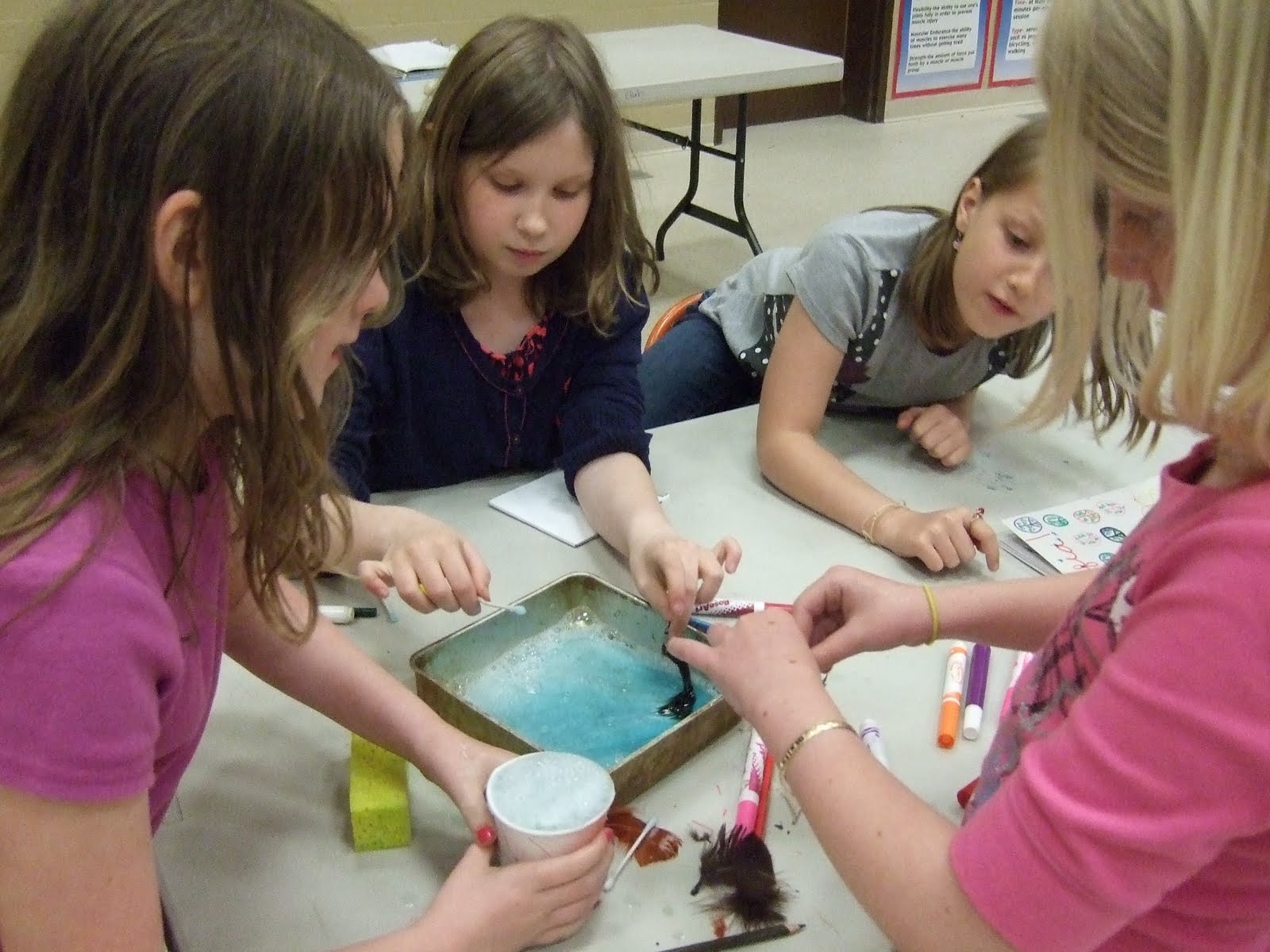
Put a bit of blue food coloring in pans of water. Add some cooking oil (which you can explain is not quite the same as crude oil) and give kids some cleaning materials such as spoons, sponges, paper, cup of dish soap, etc. Ask teams of kids to try to clean the oil from the pan. What works? What makes more of a mess? Add some feathers to the oil. Do they change? Oil is a problem for the quality of our water in Puget Sound as well as in the Gulf. How does oil get into our water locally? Hint: cars and cement. Find out more on Puget Sound Partnership's website: http://www.psp.wa.gov/oilspills.php


Aquatic Life
What can you find in Lake Washington? A puddle? A stream? Scoop out some water and take a look. You can use magnifying lenses and microscopes. Return the water and it's organisms to the location it was found when the activity is over.

Orcas in the Salish Sea!

February Environmental Education Topic: Orcas in the Salish Sea!

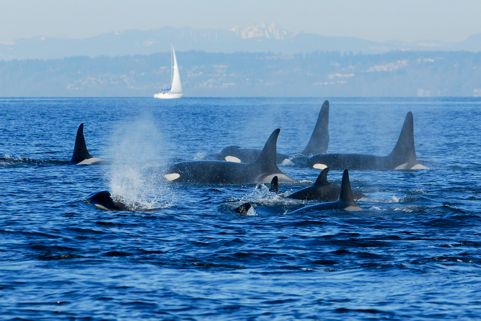
The Southern Resident Orcas, pods J, K, and L, number 88 individuals and are listed as endangered. These amazing marine mammals are intimately affected by our actions. Living in King County we see orca imagery everywhere. Why not tie a story to the icon through information and investigation?

Southern Resident Orca Facts (from The Center for Whale Research)
-The Salish Sea includes the Georgia Strait, Juan de Fuca Strait, and Puget Sound
-Orcas are commonly seen from June-September. J-Pod can be observed in our area throughout the year, while K and L pods travel farther during the winter and have been observed off the coast of Vancouver Island and as far south as Monterey, California
-Resident Orcas eat fish (salmon, herring, rockfish)
-Male Orcas can live past their 30s, females past their 50s
-Orca society is matriarchial; male and female offspring remaining with their mothers
-Orcas locate prey using echolocationn
-The Southern Resident Population was listed as endangered in 2005. Factors affecting population size may include pollution, low salmon numbers, and noise disturbances
-Other commonly observed whales and dolphins in the Salish Sea: minke whale, humpback whale, gray whale, Dall's porpoise, harbor porpoise, and Pacific white-sided dolphin


Activities

Sounds in the Sea
Using internet resources or CD's you can introduce Club kids to whale and other marine sounds. Whale singing can be so beautiful and haunting. How might boat noises affect whale communication? Use a pen to draw lines while listening. Are the lines loopey, jagged, tight, straight, irregular? Use different colored pens for different audio tracks on the same sheet of paper and create an acoustic rainbow.
Go to these sites for audio information and samples: http://www.blogger.com/www.OrcaSound.net and http://www.dosits.org/gallery/intro.htm and http://www.whaleresearch.com/audio_video.html

The Seattle Public Library has a Songs of the Humpback Whale CD you can check out. Very Cool!

Adopt a Whale
You can adopt a whale through The Whale Museum and receive information and facts, adoption certificates, monthly updates, posters, photos. geneaology chart, and classroom activity.

IslandWood's Under The Sound Video
The wonderful minds at IslandWood, Rotary, and Walllingford (Pat, Clancey, Sheely, Alisha, Grant, Adam, and Khan) created activities to accompany a short video introducing life in the Puget Sound. You can find these games, art projects, and science investigations on the positiveplace.net site. There is something here for every Club and any program time, indoors and out. Contact Christine, cmorris@positiveplace.org, for a copy of the video.

Resources
-Read Orcas of the Salish Sea to learn more about their natural his
-Visit Orca Network for information, news, photos, resources, links, and more
-Orca Network provides Killer Whale Tales activity guides
-Go to David Jamison's Sea Life Gallery for photos and information
-Visit the Puget Sound Marine Life page to find photos of your favorite local creature from tiny diatom to tremendous gray whale.
-Encourage kids on the computer to check out The Whale Museum's interactive Gentle Giants of the Salish Sea curriculum
-Killer Whale Tales.Org brings storytelling and experiential science activities to groups
-Centrum's Water World Camp and Whale Camp in Port Townsend offer scholarships
-Check out People for Puget Sound's Passport and Puget Sound Explorer Guide
-Watch this Frontline report on pollution in Puget Sound: http://www.pbs.org/wgbh/pages/frontline/poisonedwaters/

Invertebrates


March Environmental Education Topic:
INVERTEBRATES!

It is getting a little warmer outside and invertebrates are beginning to stir. Find them under rocks, in the landscaping, on plants and trees, and in the soil. Take a break from being inside and go look around!


What is an invertebrate?
-A creature without a backbone (vertebrae). Spiders, worms, insects, crustaceans. Invertebrates are the largest and most diverse animal group on earth. They come in many forms; slimy, winged, wiggly, six legs, eight legs, more.

What would you look like without a backbone?
-Floppy. Try it. Move around on the floor. Like a worm?

Then how do ants and spiders move?
-They have an exoskeleton. Imagine a knight in armor; hard on the outside, squishy on the inside. The exoskeleton provides structure for movement and protects internal organs.

If you were an insect (type of invertebrate) what would you be? Have you gone through complete metamorphosis or are you a larvae?
-Insects grow larger through a molting process. Some change form dramatically by complete metamorphosis; egg, larvae, pupa, adult.

-Find more information on invertebrates: www.kidport.com/RefLIb/science/Animals/AnimalIndexInv.htm
The Woodland Park Zoo's Teacher PowerPoint on Arthropods: http://www.zoo.org/educate/tchr_school/downloads.html

Seattle Bug Safari
at Wallingford Boys & Girls Club
Activities:

Club Invertebrate Hunt

-Do a biological survey of invertebrates around your Club. Where were the most found? How many different types (diversity). How many all together (abundance)? Inspect, investigate, draw, discuss.

Up Close
-Gently view an invertebrate up close. Use a magnifying lens if possible. How many body parts does it have? How many legs? What do its eyes look like? Draw and describe the creature. Can you act out its behavior or form? Use an insect identification book or online resource http://biokids.umich.edu/guides/invert_id/ to determine what you have found.

Pollination Relay Race
-From decomposition to pollination, invertebrates are an essential and wonderful part of our environment. Bees are known for their role in pollinating plants. Line up in two teams. One person from each team races toward a cone or "flower", then races back, does a little dance, and the next bee is free to fly to the flower and back. The first team to finish wins.