Showing posts with label Naturalist Skills. Show all posts

Tracking


Environmental Education Topic for August:
Tracking

Tracking is a great skill to practice on hikes in city parks, at sandy beaches, and even in the playground. Tracks are evidence of the wild creatures who share our urban space. Use track discoveries to provoke discussions on animal behavior, diet, movement, and the hidden lives around us. Tracking is one more way to increase awareness and hone naturalist skills.


Activities


Who Goes There?

Use field guides, http://www.princeton.edu/~oa/nature/tracking.shtml, or pages of tracks printed from the computer, http://aces.nmsu.edu/pubs/_circulars/circ561.html to identify tracks. What type of animal was it? Can you tell by the size and shape of the track? Or maybe by the spacing and orientation. Some animals bound with two feet in front and two in the back, others may pace, others may place tracks in a single file line. Sometimes tail and feather marks can be seen. Was the animal running quickly, turning around, or jumping? Use the suggestions found at this website: http://www.concord.org/~btinker/guide/tracks/tracks_db.html to carefully describe and draw all the attributes of a track.
Blank Slate

Use a board to clean an area of debris and smooth the dirt. Choose a place that might be frequently visited by animals, such as near a stream or close to fir trees. Check the area day after day for new tracks. Find tips on how to ask open ended questions about tracks and download printable field journal pages on the American Museum of Natural Hist
ory website.

Plaster Cast Tracks
You can make tracks in mud, sand, or soft dirt with replicas of hooves and paws. Or you can fi
nd tracks of wild animals and, in the city, often domestic dogs. Mix plaster according to the directions and pour it into the track including the claw marks. Let dry for at least an hour. Pry up the plaster with a butter knife or stick and refrain from cleaning the dirt or sand off until the next day when the cast is completely dry. For more information on this and other tracking activities see: http://www.bear-tracker.com/teachers.html

Guess My Gait
Tom Brown
This works well in damp sand at the park or beach. Smooth an area of sand and walk normally across it. Now walk faster along side. Create a third line of tracks by running. What changes? What part of the track is deep or scuffed? Why? Use a board to smooth the sand again. One person gets to make a line of tracks while everyone else closes their eyes. The detectives try to determine if the tracks were made by slow or fast walking, running, jumping, turning, stopping, or leaning over. Like the human tracks, animal tracks also change depending on the movement of the animal. The Tom Brown books listed below provide detailed information on how tracks change with movement.

Resources:
Tracking and the Art of Seeing: How to Read Animal Tracks and Sign
Paul Rezendes, New York:HarperCollins Publishers, Incorporated, 1999.
Tom Brown's Field Guide to Wilderness Survival
Tom Brown, NY: Berkley Press, 1983.
Tom Brown's Field Guide to Nature Observation
Tom Brown,Brandt Morgan, Berkley Publishing Group, 1989
Guides:
National Audubon Society Pocket Guide
Familiar Animal Tracks of North America
John Farrand Jr. New York: Alfred A. Knopf, Chanticleer Press, 1993.
Track Finder
Dorcas Miller, and Cherie Hunter Day
Rochester,NY: Nature Study Guild 1981
Pacific Coast Mammals: A guide to mammals of the Pacific Coast states, their tracks, skulls, and other signs 
Ron Russo and Pam Olhausen

Exploring with Senses

Environmental Education Topic for November:
Exploring with Senses

Sight, Touch, Taste, Smell, Hear; There are many ways to know the world around us. Often we rely on our vision to give us information, but it can be rewarding (and fun!) to use other senses too. What senses do local creatures use to navigate their world? Why do dogs have such long snouts? How do bats find insects to eat? Activities involving the senses are immediately engaging. Try them out!


Activities

Touch


Hold a caterpillar, squish some moss, trace the veins in a leaf, let a spider walk across your arm. What does it feel like?

Rubbings: The texture of bark, wall surfaces, wood panels, rocks, and leaves can be felt and then made visual through crayon rubbings. Simply lay paper down on surfaces, rub with colored crayons, and experiment.

Find Your Rock: Using blindfolds can heighten awareness of the other senses. After the group is blindfolded give each person a rock to feel. Let them carefully detect fissures, bumps, smooth and rough areas, weight, and size. Collect the rocks and place them in a line or pile. Everyone can take off their blindfold and try to find the rock they had just known through touch alone.

Taste Exploring the world around us through taste may not be the best idea, but this sense can be used to add an exciting dimension to science activities. Everyone likes to eat! How about making edible owl pellets? Yum! You can use your favorite cookie dough or biscuit recipe and let the Club kids add shredded coconut to represent fur and animal cookies or teddy grahms to represent the animal bones. Stir in a little black food coloring, form into pellets, bake, and enjoy! Or perhaps you can make insects with mini-marshmallows and toothpicks. Encourage use of appropriate body parts and number of legs.


Smell
Compost, flowers, earthy smells. Can you smell
damp? Can you smell dry? Can you smell when it is about to rain? It is fun to bring in dirt, flowers, and blocks of aromatic wood (leftovers at a lumber yard) for activities.
Name that Scent:
Place cotton balls in film canisters or other containers. Drop a small amount of a non-perishable liquid in each. Vanilla, almond, orange, soy sauce, etc. Let each member use their sense of smell to try and name the contents. Discuss how animals may use their sense of smell to find food, prey, or locate territory.

Hear


Musical Instruments:
Many creatures make musical sounds. The insect world is especially noisey. Some insects have body parts that act like drums or violins. Using materials found around the Club, you can make instruments and have a concert. What do the instruments sound like? How can you produce low or high tones?


Sight


Observing carefully is a skill. Club kids can develop their technique through activities, inquiry, and reflection.


Field Sketching:
Practice drawing what you see. Or perhaps sketch objects quickly in one, five, and ten minute intervals. Kids can draw a tree from memory inside, then move outside and draw from life. Place the drawings side by side. How do they change?

Weather

Environmental Education topic for October: Watching the Weather


Sneak in some science and math by watching the weather! Take the Club kids outside and make observations. What is the temperature? Cloud type? Wind speed? By tracking weather kids can look for patterns, make sense of data, and think like scientists. Record findings daily and let meteorological events inspire art and game activities.


Activities
:

Wind Gauges
Determine the direction of the wind by blowing bubbles, holding up strips of ribbon, or watching the trees move. You can build wind socks from decorated paper stapled into tubes and attached with a string to a pole or a fence. Or, if you want to get technical; build an anemometer to measure wind speed.

How Much Rain?
You can make a simple rain gauge out of materials lying around the Club. Use a can! collect the rain! Put a ruler in it! Read the result! Done! Club kids can submit their rain gauge resul
ts to Rainfall Reports. And now they are citizen scientists. You can also build a more complicated rain gauge. Why not build a barometer while you are at it? Or perhaps ask Club kids to report on the weather as they interpret it to the rest of the Club. Making rain graphs and measurements, math can become relevant to direct observations and predictions.

Joke: What should you do if it is raining cats and dogs?
Try not to step in a poodle!

I See Cloudy!
Does that Cumulonimbus cloud look like Dan Ackroyd or is it just me? Go to the USGS website for a cloud type chart. Defining clouds can heighten awareness of atmospheric phenomena and develop attention to detail. Plus it is just plain calming. Check out 'The Cloudspotter's Guide: the Science, History, and Culture of Clouds' from the library and prepare to be amazed. Did you know that a man upon ejecting from a plane fell into a thundercloud and was tossed around in it for half an hour before safely parachuting to the ground? yes!

More
For instructions on activities enticingly named 'Make Lightning', 'Cloud in a Jar', 'Make a Tornado', and more, go to Web Weather for Kids.

Birding by Ear


July Environmental Education Topic:

Birding
by Ear


What did the Owl do when he lost his voice?


He didn't give a hoot!


Bird sounds are all around us. Some are short and sharp; others more intricate. We can identify birds by their vocalizations and encourage development of this listening skill with our youth. How many bird voices can you recognize? Crows, gulls, pigeons, robins, house sparrows? How about northern flickers, chickadees, and starlings? Birding by ear teaches a new level of awareness and brings attention to the lives around us at the park, on the street, and outside our Clubs.

Bird Information, photos, and songs can be found on http://www.allaboutbirds.org/NetCommunity/Page.aspx?pid=1189

Activities


Who's Call?
Gather together some empty containers. Fill pairs of containers with the same substance. Beans for one pair, rocks in another, rice, bells, pasta shells. Kids will each get a container. Everyone shakes their container listening carefully to find their pair making a matching sound. Before this hold a discussion. Why do birds sing? Do different birds have different voices? What are some bird voices you have heard outside the Club? Background information on why and when birds sing can be found on http://gorp.away.com/gorp/publishers/lyonspress/bir_ear.htm


Sound Map
This activity can be done in a park or area away from lots of traffic noise. And the silence it encourages can be a relief in the middle of busy camp day. Ask the kids to quietly listen for a minute and count how many different sounds they can hear. What were they? Wind in trees, birds, water, crunching footsteps. Hold up a piece of paper and make an x to represent you. Draw in the sounds that you hear around you. The sounds can be squiggly or jagged lines, circles, or words describing the sound. You can add some visual landmarks as well. Explain that the kids will make a sound map by sitting alone and quietly listening. They will draw as many sounds as they can hear on their map.

Bird Song Bingo (contact Christine; cmorris@positiveplace.org to request materails)
Use a CD of bird songs and bird photo game cards to play Bird Song Bingo. First play each song on the CD and ask kids to guess the name of the bird. Show the picture of the bird from the game card. Play the CD again and have kids call out the name of the bird. Then pass out the game cards and bingo markers. Play tracks from the CD. Kids mark the photo on the card for the song that is played.


Black Capped Chickadee Singing


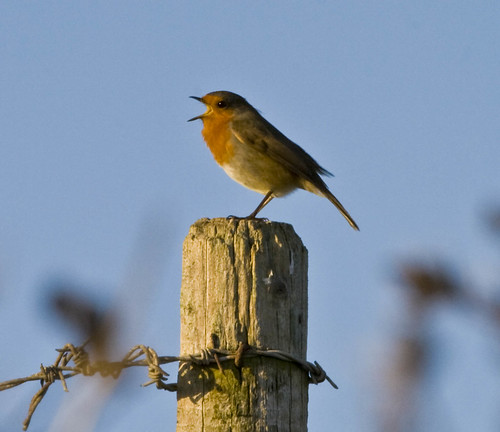
American Robin Calling